Cobble Stones Chapter
Bylaws
COBBLE STONES CHAPTER BYLAWS
1. Introduction & Purpose
1.1 Chapter Foundation
The Cobble Stones Chapter of the Widows Sons Masonic Bikers Association (WSMBA) is a non-commercial, non-profit organization aligned with the National WSMBA. The Chapter’s bylaws adhere to the National Constitution, and all new members are provided with copies of these documents, which are also accessible online.
1.2 Membership Types
- Full Membership is open to Master Masons in good standing with the United Grand Lodge of England, Ireland, or Scotland who regularly attend a Masonic lodge.
- Associate Membership (Clickers) is available to non-Masons or Masons below the rank of Master Mason. Clickers enjoy many of the same benefits as Full Members, though they cannot hold office.
1.3 Purpose of the Chapter
The core mission of the Cobble Stones Chapter is to promote Freemasonry and motorcycling, while fostering camaraderie among members. The Chapter also dedicates itself to raising funds for Masonic and non-Masonic charities, exemplifying the fraternity’s charitable nature while engaging in shared enjoyment of motorcycle riding.
2. Membership Guidelines
2.1 Full Membership (Masonic)
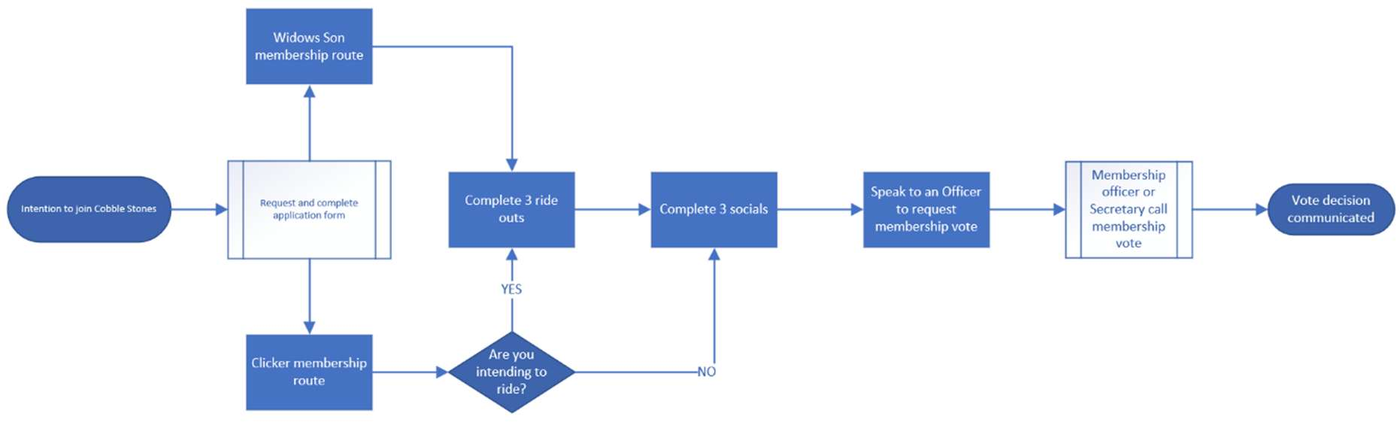
Full Membership is granted to Master Masons in good standing who meet the following criteria:
- Motorcycle Ownership: The member must own and maintain a roadworthy, legal motorcycle or trike that complies with Chapter regulations.
- Lodge Clearance: Applicants must provide a clearance certificate from their Masonic Lodge to confirm their good standing.
- Participation: Full Members are required to complete:
- Three social events: These events allow both the Chapter and the applicant to assess mutual compatibility. Social events can include meals, informal meetings, or official gatherings prior to ride-outs.
- Three Chapter ride-outs: These ride-outs help evaluate the applicant’s riding safety and compatibility with the group. A ride-out must involve at least four bikes and be organized by a Ride Captain or a delegate.
- Application: Completion and submission of the Chapter's membership application form is required.
If a Mason applies for membership but is awaiting elevation, they may join as an Associate (Clicker) until their elevation to Master Mason.
2.2 Associate Membership (Clicker)
Associate membership is open to non-Masonic members, including the partners, family, or friends of members. While Clickers are not eligible for office or to vote on Masonic matters, they are a valued part of the Chapter. Clickers who ride must comply with the same motorcycle and safety requirements as Full Members.
- Social Event & Ride-Out Participation: Clickers wishing to ride with the Chapter must complete:
- Three social events: This allows time to build rapport and for both the Chapter and the Clicker to become acquainted.
- Three ride-outs (for riding members): This ensures the rider's safety and compatibility with the Chapter.
- Non-riding Clickers are exempt from the ride-out requirement.
2.3 Special Membership Provisions
- If a member sells their motorcycle, they have 12 months to acquire another. During this time, they may retain Full Membership. After 12 months, if no new vehicle is acquired, the member will convert to Associate (Clicker) status.
- If a member is forced to stop riding due to illness or injury, they may be voted honorary Full Members at the discretion of the Officers, allowing them to retain their Full Membership without needing to ride.
3. Chapter Insignia & Patches
3.1 Patch Policy
Members are permitted to wear “cuts” (vests) with approved Chapter and WSMBA patches, adhering to the following guidelines:
- No Offensive Material: Members must not wear any patches, badges, or clothing intended to offend others at any Chapter or WSMBA event. This includes, but is not limited to, political, discriminatory, or inflammatory graphics.
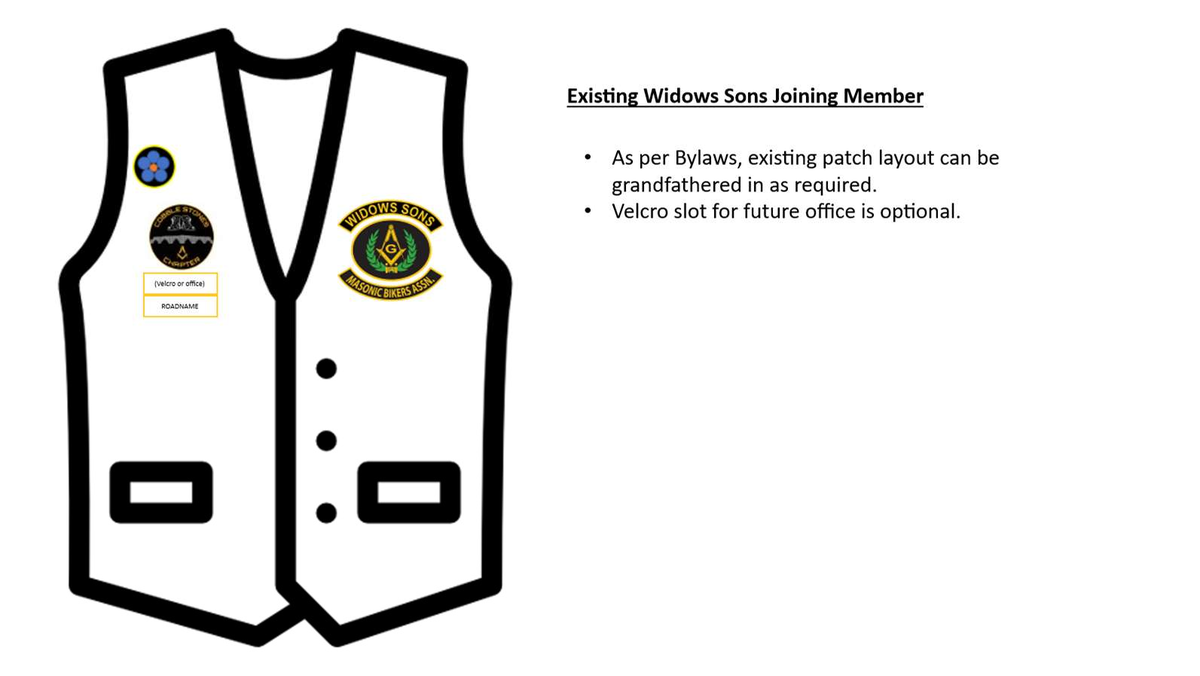
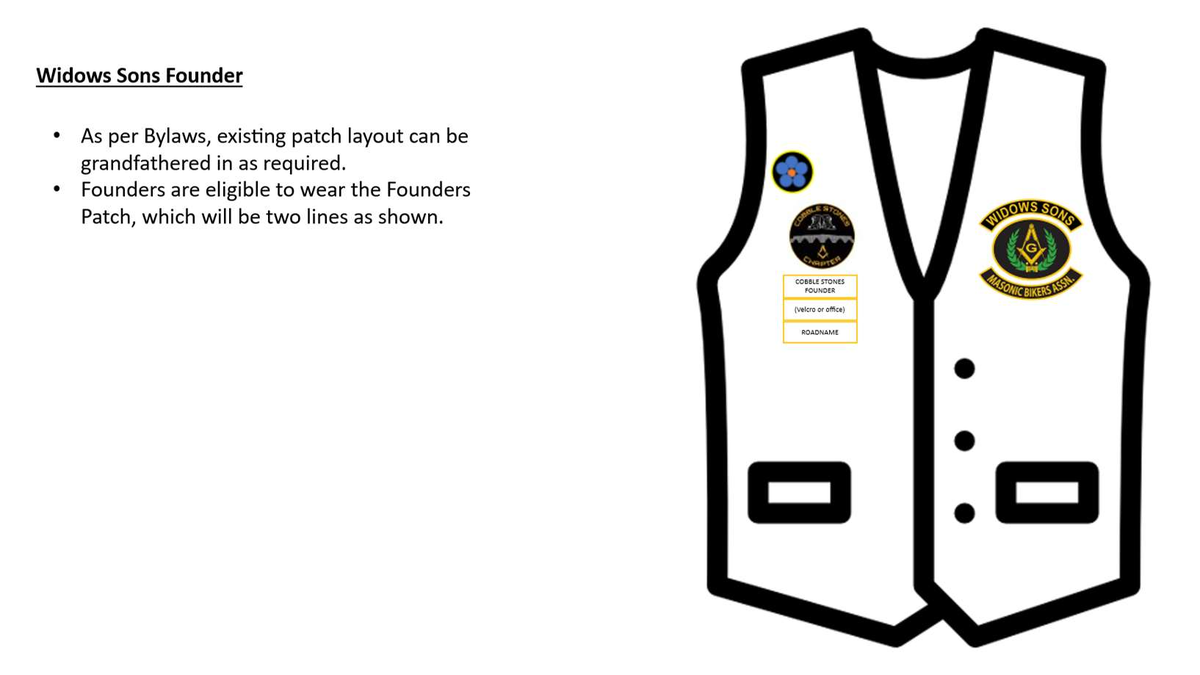
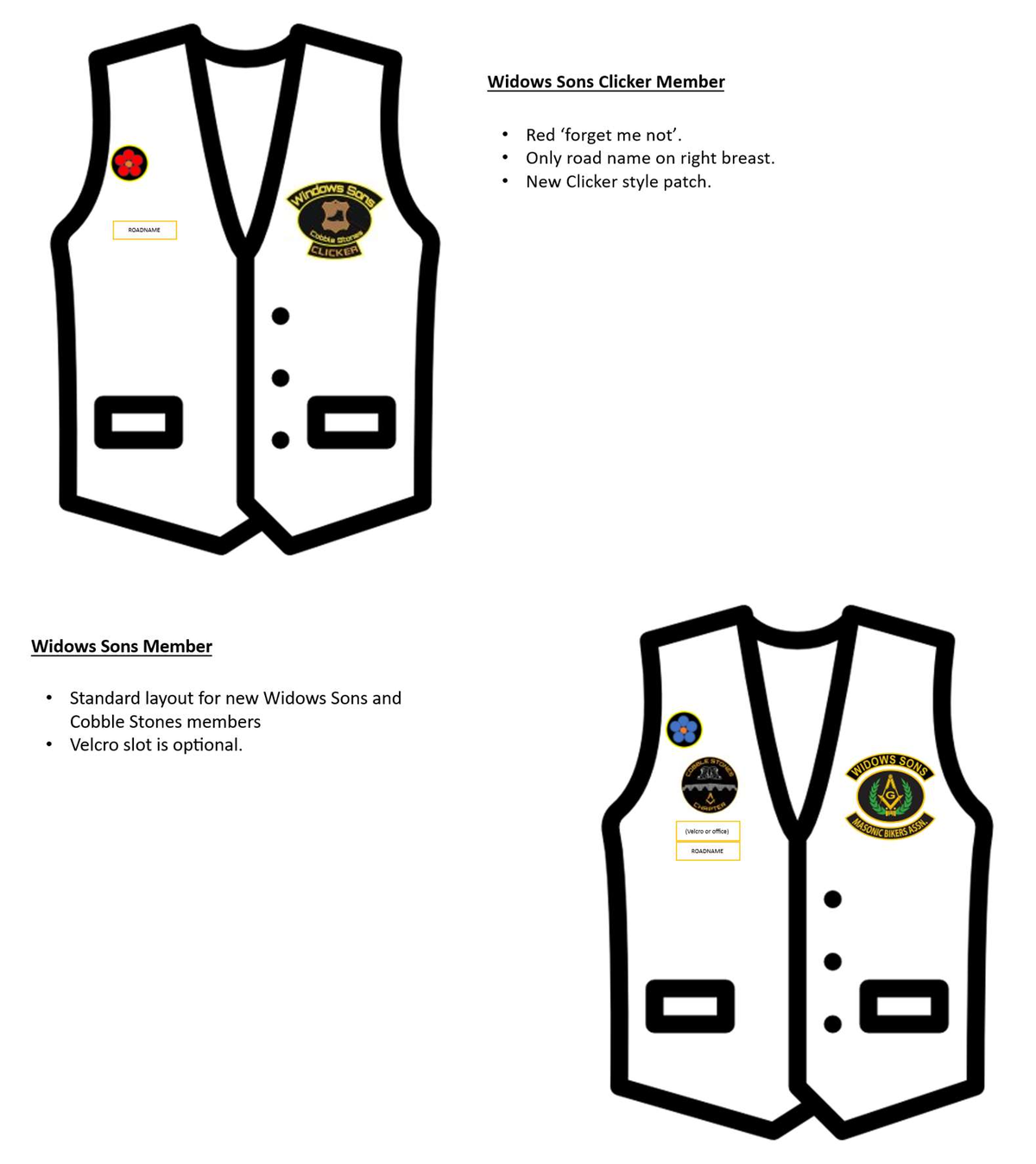
- Patch Locations: Chapter patches must be worn in the prescribed locations, as outlined in the visual guide provided. Patches from other legal motorcycle groups are allowed on the front of cuts, provided they do not detract from or conflict with the WSMBA and Cobble Stones Chapter patches.
- Existing Patch Placement: If a member joins with existing patches, they are not required to move them unless they conflict with the Chapter or WSMBA Constitutions.
3.2 Back Patches
Back Patches will be permitted providing the following requirements are met
- Type and Nature: All patches will be respectful in nature, be of Personal, Masonic, Military or other commemorative or affiliate type.
- Unauthorised Patches: No patches which resemble mimic or copy symbols or other recognised design of other M/C clubs or groups such as but not limited to HA, Outlaws, 1% or other such organisations which might be considered analogous in any way will not be permitted.
- Express Exclusions: Under no circumstances will any Top or Bottom Rocker, Death Heads or anything that could be reasonably considered a similar representation of such will be worn.
- Approval: Final adjudication of what would constitute an “approved type” is the gift of the Committee with the President holding a casting vote. The decision of the Committee and President is final.
4. Motorbike and Trike Guidelines
4.1 Riding Requirements
- Vehicle Standards: All members’ motorcycles and trikes must be fully roadworthy, with valid MOT, insurance, and road tax as required by UK law. Trikes are included under the same regulations as motorcycles.
- Licensing: Riders must hold the appropriate valid license for the vehicle they are riding. If a trike rider has military or police experience but their license has expired, this may be considered.
4.2 Group Ride Considerations
- Safety and Speed: The Chapter prioritizes safe group riding. Therefore, motorcycles or trikes with engines that cannot maintain the necessary pace may not participate unless an exception is granted by the Ride Captain. Classic motorcycles may be allowed under certain conditions, depending on the nature of the ride and its required speed.
- Compliance: All participants in ride-outs must comply with UK road traffic laws, as well as the laws of any country they are visiting. Failure to do so will result in disciplinary action.
5. Conduct & Disciplinary Measures
5.1 Conduct Expectations
The Chapter expects all members to uphold values of respect, unity, and mutual support. Members should:
- Refrain from discussing political or religious matters during Chapter events, as these topics can create division.
- Avoid any behaviour that could lead to segregation, exclusion, or bullying.
- Report incidents of misconduct to the President or another Officer, who will address these issues promptly.
5.2 Three-Strike Rule
The Chapter employs a three-strike disciplinary system for maintaining high standards of conduct (indicative and not exhaustive):
- One Strike: Issued for minor violations, such as disruptive behaviour during meetings or mild inappropriate conduct on social media.
- Two Strikes: Issued for more serious offenses, such as repeated failure to follow Chapter rules or disrespect towards fellow members.
- Three Strikes: Issued for major infractions, including harassment, discrimination, or any violent behaviour.
Members who accumulate three strikes within a year will be expelled from the Chapter. All disciplinary actions are decided by a majority vote of the Officers.
6. Leadership & Governance
6.1 Officer Roles
The Chapter’s leadership consists of the following Officers:
- President: The President provides overall direction for the Chapter, ensures harmony, and represents the Chapter externally.
- Vice President: Assists the President and steps in when the President is unavailable.
- Secretary: Responsible for maintaining all Chapter records, managing correspondence, and recording meeting minutes.
- Treasurer: Manages all financial matters, including the Chapter’s accounts, budgets, and financial reports.
- Road Captain: Organizes and leads ride-outs, ensuring the safety and coordination of all riders.
- Membership Officer: Oversees the recruitment and onboarding of new members.
- Charity Steward: Coordinates charitable activities and ensures the Chapter’s fundraising efforts align with its goals.
- Almoner: Provides support to members in need, ensuring that their welfare is addressed.
- Founder: Is one of the original founding members. Although not an official office, founders are granted continued rights to participate in Office chat and groups.
6.2 Officer Appointments and Terms
- Officers are elected annually at the Annual General Meeting (AGM), except for the Secretary and Treasurer, who serve two-year terms.
- No President shall hold office for more than three consecutive years. If no suitable candidate is available to replace the President after this period, the current President may continue, with approval from the WSMBA Grand Board.
7. Finances
7.1 Bank Accounts and Financial Management
- The Chapter’s bank account will be held with an agreed-upon provider. The President and Treasurer will be the primary signatories.
- Payments up to £149 may be authorized by either the President or Treasurer. Payments exceeding £150 require approval from the Officers.
- Emergency charitable donations of up to £100 may be approved by the President and Almoner, with immediate notification to the Officers.
7.2 Financial Reporting
- The Treasurer will present a full financial report at the AGM, with summaries posted to the Chapter's WhatsApp group beforehand for transparency.
- Financial summaries, including available charity funds, will also be provided before each Officer meeting.
8. Meetings & Voting
8.1 Annual General Meeting (AGM)
The AGM is held annually on or near the first Sunday of October. All members are encouraged to attend to discuss Chapter business, vote on new Officers, and review financial reports.
8.2 Voting Procedures
- Any member can call for a vote, which must be seconded by another member.
- Voting may take place either before meetings in some cases, during meetings or via the appropriate WhatsApp group/online portal.
- The President will cast the deciding vote in case of a tie.
- The Secretary can call a vote without requiring a second as part of conducting regular Chapter business.
- A founder is not considered an Officer for the purposes of voting.
- A proposed amendment to the bylaws once voted, the same proposal cannot be proposed and voted on again for at least 6 months.
*In all cases Presidents vote choice break any tie.
| Category | Situation | Officer | Patched WS Member | Patched Clicker | Non Member | Vote Type |
|---|---|---|---|---|---|---|
| Chapter Operations | Vote Officer in to office | X | X | Majority vote | ||
| Vote Officer out of office | X | Majority vote | ||||
| Member discipline decisions | X | Majority vote | ||||
| Spending decisions | X | Majority vote | ||||
| Interpretation of bylaws | X | Majority vote | ||||
| Agree release of updated bylaws document | X | Majority vote | ||||
| Vote in new member | X | X | Two 'no votes' blocks joining for min of 6 months |
9. Complaints & Disciplinary Process
The complaints process ensures that all concerns are addressed fairly and transparently. Complaints must be submitted in writing to the President or Secretary and must include the complainant’s name, the date, a detailed description of the incident, and any supporting evidence or witness names. Investigations will be conducted impartially, with the findings presented to the Officers for a vote. Full details of the process are outlined in Appendix 1.
APPENDIX 1- Complaints and Disciplinary Process
1. Complaint Submission
Form Content:
Complainant's Name
Date of Submission
Detailed Description of the Incident
Names of Any Witnesses
Supporting Evidence (if any)
1.1 Complainant: Completes the Complaint Form.
1.2 Complainant: Submits the Complaint Form to the President (or delegated to Secretary).
Key Terms:
Evidence: Any form of proof submitted to support the complaint, such as documents, messages, emails, or recordings.
Witness: An individual who has firsthand knowledge of the incident and can provide a statement.
2. Initial Review by President (or delegated to Secretary)
Criteria for Review:
Completeness of Complaint Form
Relevance to Chapter Bylaws or WSMBA Constitution
Pass/Fail:
Pass: Complaint is complete and relevant; proceed to investigation.
Fail: Complaint is incomplete or irrelevant; notify complainant and close the case.
2.1 President (or delegated to Secretary): Reviews the Complaint Form.
2.2 President (or delegated to Secretary): Makes an initial decision.
Key Terms:
Unbiased: Conducting the review without favouritism or prejudice, ensuring a fair assessment.
3. Notification of Parties
3.1 President (or delegated to Secretary): Notifies the Complainant of the receipt and initial review result.
3.2 President (or delegated to Secretary): Notifies the Accused of the complaint and pending investigation.
4. Investigation Process
4.1 President (or delegated to Secretary): Assigns an officer to lead the investigation.
Methodology:
Gather Statements from Involved Parties
Collect Any Additional Evidence
Interview Witnesses
Review Relevant Chapter Bylaws and WSMBA Constitution
Quality Standards:
Thorough and Unbiased Gathering of Information
Clear and Detailed Documentation of Findings
Thresholds for Evidence:
Corroborative Testimonies from Multiple Sources
Documented Proof (e.g., messages, emails)
4.2 Investigation Officer:
Gathers statements from involved parties.
Collects any additional evidence.
Interviews witnesses.
Reviews relevant Chapter Bylaws and WSMBA Constitution.
4.3 Investigation Officer: Documents findings, ensuring:
Thorough and unbiased gathering of information.
Clear and detailed documentation of findings.
Corroborative testimonies from multiple sources (if possible).
Documented proof (e.g., messages, emails).
4.4 Investigation Officer: Provides regular updates to:
Officers Group on the progress.
Complainant and Accused on the process status.
Key Terms:
Corroboration: Supporting or confirming evidence or statements that strengthen the validity of the claims made.
5. Completion of Investigation
5.1 Investigation Officer: Submits a comprehensive report to the President (or delegated to Secretary).
Report Content:
Summary of the Complaint
Summary of Evidence Gathered
Statements from Witnesses
Analysis of Findings
Conclusion and Recommendations
Guidance for Report:
Ensure clarity and conciseness.
Maintain objectivity and neutrality.
Use structured headings for easy navigation.
Include supporting documents as appendices.
The Secretary can assist with compiling and formatting the report.
5.2 President (or delegated to Secretary): Reviews the report and presents findings to the Officers Group.
6. Voting on Charge
6.1 Officers Group: Reviews investigation findings and evidence.
6.2 Officers Group: Conducts a vote on whether the charge is valid.
Majority vote required to determine validity.
7. Voting on Sanction
7.1 Officers Group: If the charge is valid, votes on the appropriate sanction.
Options: No Sanction, 0 Strike (verbal warning), 1 Strike, 2 Strikes, 3 Strikes.
Majority vote required for the decision.
8. Communication of Decision
8.1 President (or delegated to Secretary): Notifies the Complainant and Accused of the decision and any sanctions imposed.
8.2 President (or delegated to Secretary): Informs the Chapter of the decision while maintaining confidentiality of sensitive information.
9. Documentation and Record-Keeping
9.1 Secretary: Maintains records of:
Completed Complaint Forms
Investigation notes and evidence
Communication records
Voting results and decisions
Final reports
9.2 Secretary: Regularly reviews documentation to ensure compliance and accuracy.